 List
List
ATE is Advanced Technological Education. With an emphasis on two-year colleges, the National Science Foundation's ATE program focuses on the education of technicians for the high-technology fields that drive our nation's economy.
Commercializing Industrial Biotechnology (CIB)
Conference
September 22 Chicago, IL
The Commercializing Industrial Biotechnology (CIB) conference spotlights best practices, lessons learned, and technology innovations for accelerating commercial production of bio-based products and building the circular bioeconomy. This is the premier conference focused on scale-up and commercialization of new products in the synthetic biology, fermentation, and industrial biotechnology spaces.
You’ll engage with industrial biotech leaders and practitioners as you explore the latest in the field — including developments that are driving a new wave of products. At CIB, you'll hear hard-won lessons from industry veterans — and draw inspiration for your own technology development efforts while learning and networking about new enabling technologies, products, market needs, and companies.
(View More)
2026 National Cybersecurity Virtual Career Fair
Student Event
September 22 Online
This virtual career fair connects students from institutions designated as Centers of Academic Excellence in Cyber-Defense (CAE-CD), Cyber Operations (CAE-CO), and Research (CAE-R), as well as Candidate program institutions, with cybersecurity employers.
(View More)
Evaluation Reports Everyone Can Use: Accessibility Practices for ATE Evaluators
Webinar
September 23
A well-written evaluation report still falls short if people can’t actually access it. For evaluators working with NSF ATE projects, accessibility means more than meeting federal standards under ADA Title II, which applies to public institutions and the digital content they produce. It means creating reports that everyone can access and understand in order to make sound evaluation decisions.
This webinar walks through what evaluators need to know to prepare accessible reports. Presenters will cover document structure, plain language and formatting practices, and other considerations for anyone communicating evaluation findings. You’ll leave with practical strategies you can put to use in your next report, whether you’re just starting to think about accessibility or want to sharpen practices you already have in place.
Accessibility isn’t an extra step. It’s part of what quality evaluation work looks like. Join to make sure your reports reach everyone they’re meant to reach.
(View More)
A Proven Pathway to NSF ATE Success
Webinar
September 23
Tap into expert guidance and insider ATE Program knowledge—without spending a dime! Join this information-filled webinar to explore the latest solicitation and learn how free mentoring through Mentor-Connect can help you develop a competitive, successful proposal.
(View More)
AMTEC Community of Practice: Turning Industry Trends into Classroom Opportunities
Webinar
September 24
Join the AMTEC Institute for Industry 4.0 Innovation (NSF ATE DUE 2350012) Community of Practice session on September 24th at 3pm (CT)! As automation and AI continue to transform manufacturing, workforce readiness has never been more important. Christelle Keefer, A3's Director of Training and Certification, will lead the session and explore today's workforce challenges, the growing skills gap, and practical strategies for preparing students for high-demand careers. Learn how A3's vendor-neutral training, certifications, and educational resources can help educators integrate Industry 4.0 concepts into the classroom and strengthen the connection between education and industry.
(View More)
MATE ROV Academy Teacher Workshop - Sheboygan, Wisconsin
Workshop
September 25 Sheboygan, WI
This free teacher workshop covers the scientific and technical concepts behind underwater robotics and ROV building. Dive into the scientific and technical concepts behind underwater robotics and learn how to apply them to building a SeaMATE ROV kit, practice navigation skills in the pool, and develop strategies to prepare a student team for the MATE ROV Competition. Participants receive a SeaMATE ROV kit, power supply, MATE ROV Academy toolkit, and Underwater Robotics textbook along with travel support.
(View More)
Lead Through the Noise
Summit
September 28 Washington, DC
Today’s community college leader faces constant change and disruption. Lead Through the Noise is a special edition of AACC’s Future Leaders and Presidents Institutes programming which will focus on the skills needed to better navigate challenges while setting yourself up to model the resilience, agility, and emotional intelligence needed in today’s world. Sessions will be rooted in the AACC Competencies for Community College Leaders in addition to special topics such as navigating disruptions, sensemaking in a complex environment, and treading in politicized waters.
(View More)
Fueling the Future: Nuclear Energy
Meeting
September 28 Online
CREATE Faculty Coffee Hours are a time to get together (virtually) and discuss topics of interest for Energy Faculty each month.
Please come to these sessions prepared to share your experiences and ideas on the specified topic (what has worked or maybe what hasn’t worked). If you don’t have experiences or ideas on the specific topic, please come and learn from your colleagues. This will be an opportunity to share and brainstorm ideas together.
(View More)
EDUCAUSE Annual Conference
Conference
September 29 Denver, CO
The EDUCAUSE Annual Conference connects the best thinkers in higher education technology.
This is an event where professionals and technology providers from around the world gather to network, share ideas, grow professionally, and discover solutions to today’s challenges. It’s the largest gathering of your peers…people you can relate to, learn from, and stay connected to throughout the year.
(View More)
National Coalition of Advanced Technology Centers Annual Conference 2026
Conference
September 30 Tacoma, WA
The National Coalition of Advanced Technology Centers (NCATC) is an Affiliated Council of the American Association of Community Colleges (AACC) catalyzing a network of higher education and industry-led Strategic Partner resources that advocates, advises, and promotes the use of advanced technology applications to enhance economic and workforce development programs and services. With over 160 members from community and technical colleges, universities, CTE high schools, adult education organizations and the corporate community, NCATC provides great networking opportunities at both their Summer Workshop and Fall Conference every year.
(View More)
AMTEC Institute for Industry 4.0 Innovation
Workshop
October 6 Owensboro, KY
Join an immersive two-day experience designed specifically for manufacturing instructors and faculty at high schools, community and technical colleges, and universities. Gain practical, hands-on expertise with cutting-edge Industry 4.0 technologies and proven strategies you can immediately apply in your classroom.
Sessions Include:
- Industry 4.0 Concepts and Training
- Artificial Intelligence and Augmented/Virtual Reality
- Competency-Based Education and Funding Resources
Reception evening before on October 5, 2026 from 5pm to 7pm (CT) to network with fellow instructors and trainers.
(View More)
ACTE Best Practices Conference 2026
Conference
October 6 Denver, CO
The ACTE Best Practices Conference showcases effective career and technical education (CTE) programs, instructional strategies, and workforce partnerships. Hosted by the Association for Career and Technical Education, the conference brings together CTE administrators and education leaders to share innovative practices, explore professional learning opportunities, and strengthen program quality and student outcomes across K–12, postsecondary, and workforce systems.
(View More)
2026 Career Connect
Student Event
October 13 St. Paul, MN
Career Connect gives high school students an opportunity to explore career pathways and connect directly with professionals from more than 100 businesses and organizations. More than 1,000 students are expected to participate in this interactive career exploration experience.
Students will discover educational and career opportunities across six sectors, including Agriculture, Food and Natural Resources. Participating organizations will offer hands-on activities, technology demonstrations and conversations that help students understand the skills, training and education needed for different careers.
Career Connect is designed to help students see what is possible after high school and begin shaping their own paths toward college, technical education, skilled trades or the workforce.
(View More)
ATE Projects and Centers

Mfg
Advanced Manufacturing Technologies topics include:
- Additive manufacturing
- Automotive manufacturing
- General manufacturing
Ag/Env
Agricultural and Environmental Technologies topics include:
- Agriculture and aquaculture
- Environmental technologies
- Natural resources
- Nuclear power
- Solar energy
- Wind power
Bio/Chem
Bio and Chemical Technologies topics include:
- Biotechnology
- Chemical and process technologies
Eng
Engineering Technologies topics include:
- Electronics and controls
- General engineering
- Marine technologies
- Materials technologies
- Optics
- Space technologies
Gen
General Advanced Technological Education topics include:
- Evaluation
- Learning research
- Recruitment
- Teacher preparation
Info
Information and Security Technologies topics include:
- Geospatial technologies
- Information and communications technologies
- Logistics
- Security, information assurance, and forensics
Nano
Micro and Nanotechnologies topics include:
- MEMS
- Microsystems
- Semiconductors
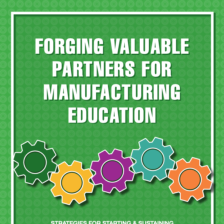
This 32-page guide from the Florida Advanced Technological Education Center (FLATE) shares best practices for building partnerships between schools and the advanced manufacturing industry. In this resource, FLATE outlines strategies for informing parents and students about advanced manufacturing careers, focusing on Florida but with information relevant to other states. Readers will explore partnership tools such as scholarships, internships, industry advisory boards, adjunct faculty instructors who currently work in industry, and facility tours. This document offers tips for sharing the environmentally friendly, creative, and socially responsible aspects of manufacturing careers. Guidance is also provided for outreach to female students, parents, younger students across K-12 grade levels, and the school’s community.
Chapters include School & Industry Partnership Tools, Targeting Advanced Manufacturing’s Softer Side, Targeting Girls & Young Women, Targeting the Future Workforce...
(View More)

This issue of J ATE, published by Portland Community College, is issue two of the journal's second volume and focuses on the theme of undergraduate research at community and technical colleges across the United States. J ATE is a peer-reviewed technical journal focused on community college faculty and staff who work with technician education. This journal is cross-disciplinary and encompasses all technologies under the National Science Foundation (NSF) Advanced Technological Education (ATE) Program. Some of these technologies include: Micro Nano, Biotechnology, Autonomous Technology, Cyber Security, Advanced Manufacturing, Earth Sciences, Agriculture Technology, Energy, and Welding. Some topics that cross cut across all disciplines of technician education are also covered. Those topics include: Evaluation, Mentoring, Undergraduate Research, and Applied Technician Research.
This 115-page issue of J ATE includes ten full articles and five guest letters written by ATE professionals....
(View More)
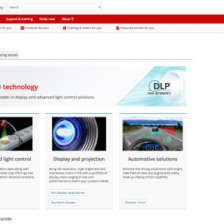
This web site, provided by Texas Instruments Incorporated, describes the DLP projection system, an optical semiconductor known as the DLP chip. The web site is divided into the following sections: Advanced light control, Display and projection, Automotive solutions, and Technical resources.
(View More)

This lab, presented by the National Nanotechnology Coordinated Infrastructure, uses silver nanoplates as a tool to explore the relationship between shape and optical properties. Students will be able to compare material properties and behaviors at both the nano- and macroscale through the exercise, as well as experience with scale and unit conversion. A 'Teacher's Preparatory Guide' is included, featuring needed materials, detailed procedural instructions, and additional resources. A 'Student Guide' includes detailed, step-by-step instructions, space for recording data, and analysis questions.
(View More)
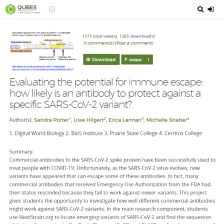
In this activity, provided by Digital World Biology, students use free, online biotechnology resources to investigate how well different commercial antibodies might work against SARS-CoV-2 variants. Students will first use NextStrain.org to locate and detect the spike proteins of emerging SARS-CoV-2 variants. Next, they will "use iCn3D and BLAST to align the sequence of the variant spike protein to a sequence of a spike protein that is bound to a commercial antibody." After identifying mutations in the antibody binding site, students will then compare "chemical bonds that would be formed between the original amino acid and the antibody with the predicted bonds that could be formed by the variant amino acid and predict whether their antibody will be effective against their variant."
Included is a 3-page instructor guide detailing each step of the activity, a 2-page student instructional sheet, activity materials, such as data spreadsheets, and an informational video on using...
(View More)
| Active ATE Centers | 14 |
| Active ATE Projects | 257 |
| ATE Resources | 7,149 |
| New Projects/Centers | 92 |
| New Resources | 123 |
ATE Resources by Subject Area
ATE Events by Subject Area
Upcoming Webinars: Evalu-ATE and Mentor-Connect
On September 23, both Evalu-ATE and Mentor-Connect are hosting webinars regarding evaluation and funding opportunities. From 12 p.m.- 1 p.m. CST, Evalu-ATE is hosting “Evaluation Reports Everyone Can Use: Accessibility Practices for ATE Evaluators.” This webinar will explore what evaluators need to know to prepare accessible reports. Information on document structure, plain language, formatting, and other communication strategies will be provided. Attendees will leave with practical strategies to implement while writing their next report!
After this webinar, join Mentor-Connect and NSF to explore funding opportunities! This webinar will take place at 2 pm CST and inform attendees on how free mentoring through Mentor-Connect can help you to develop both a competitive and successful proposal.
To learn more about these webinars or to register, visit the Evalu-ATE webinar page and the Mentor-Connect registration page.
(View More)

Upcoming Event: ATE PI Conference
The annual ATE Principal Investigators (PI) conference is taking place this year from October 21-23 in Washington, D.C. This conference is hosted by the American Association of Community Colleges (AACC) in partnership with the National Science Foundation (NSF), with more than 800 NSF ATE grantees and partners in attendance. Registration is primarily limited to the principal investigator, co-principal investigators, and team members of ATE-funded grants. Additional attendees may register through association with an ATE grant team. This year's theme is “ATE in Action,” reflecting the work of the projects and centers that make the ATE community strong.
The ATE conference is an opportunity for the national ATE community to convene, advancing STEM technician education through the leadership of community and technical colleges working in partnership with business and industry, secondary and postsecondary education, and other key stakeholders. The deadline to register for the conference is September 24th.
To learn more about the conference or to register, visit the ATE in Action website.
(View More)

New Issue: Community College Journal
The American Association of Community Colleges (AACC) has released the August/September edition of the Community College Journal! This journal offers contemporary information, insights, strategies, and connections for those in academia, industry, government, and workforce development.
This edition, entitled “Beyond the Classroom,” includes information on student housing solutions, community colleges refining their library experiences for students, and the role community colleges play in civic engagement. The August/September publication is available online, and archived issues can be viewed in the AACC library.
(View More)